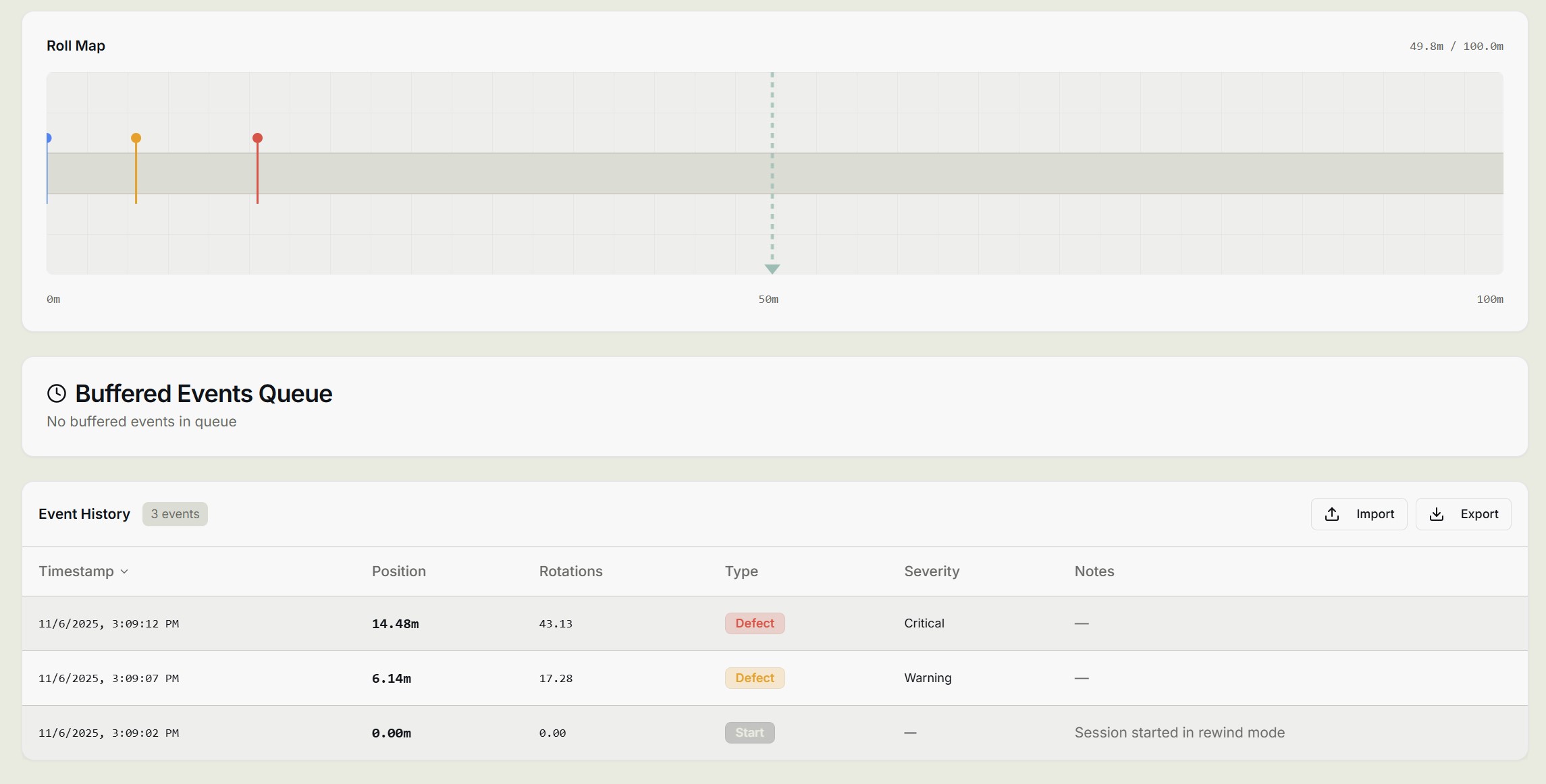
Roll Tagger builds a digital map of every roll as it winds — recording defects, splices, and quality events at precise positions. On the unwind, that map drives automated waste removal. No physical tags. No manual watching. The system runs entirely on-premise using industrial Revolution Pi controllers with dual encoder inputs for sub-millimetre position precision.
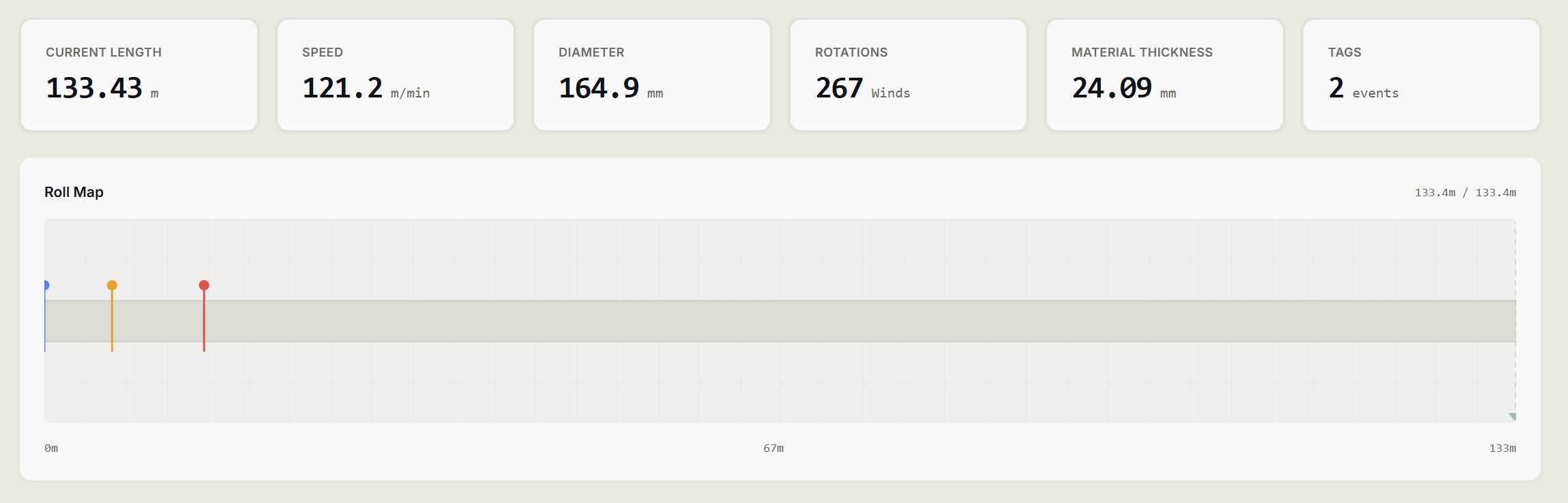
As material winds onto the roll, Roll Tagger records every millimetre. Dual encoder data calculates real-time diameter, thickness, speed, and rotation count — building a precise digital twin of the roll.
On the unwind, Roll Tagger loads the rewind map and plays it back against the live encoder feed. Events trigger configurable machine actions — stop, jog, or skip — eliminating manual watching.
Track defects through multiple processes and remove at the final operation such as slitting. Full roll lineage and parent-child traceability across every production station.
Automatic quality checks at every 10-wind milestone comparing actual to expected position from the source rewind map. Deviation alerts for positional anomalies.
Three-queue architecture (input, output, backlog) for multi-station workflows. Rolls transfer automatically between devices via .rtag file handoffs over the local network.
Digital I/O to interface with vision systems, splice detectors, and turret rewinders. REST API and batch CSV import for MES/ERP integration.

Digital twin of every roll, three-queue architecture, yield analytics, plant-floor deployment.
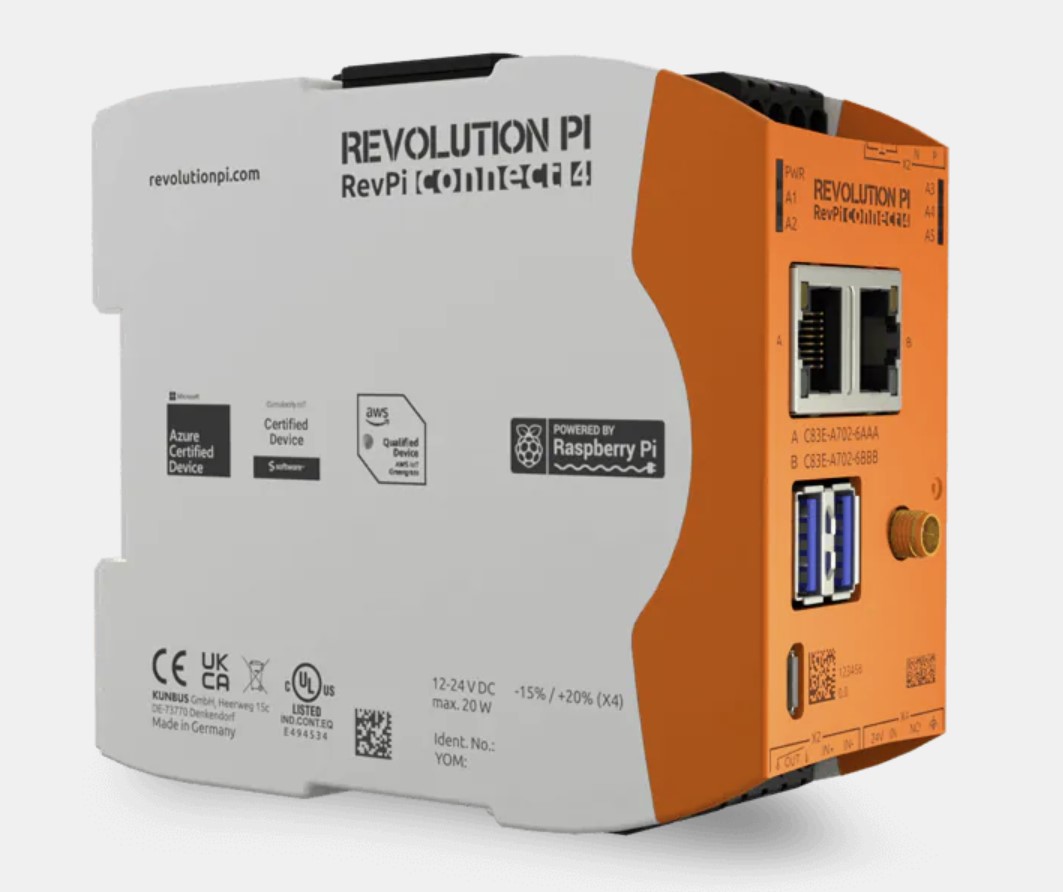
Learn moreRevPi Connect 4, RevPi DIO and absolute rotary encoder: industrial, off the shelf.
Learn more
What is involved from first install to first roll.
Learn more
User manual, support documentation and FAQ for customers. Login required.
Learn moreRoll Tagger is the plant I/O interface for the roll record. Beyond encoder position and roll identity, it captures the handful of events that let Roll Grader read every defect in the context of the line.
| Job start and end | Anchors the startup template and names the product whose rules apply |
|---|---|
| Line speed setpoint change | Shifts drying, tension and gauge, and every MD-to-time conversion |
| Roll change and splice | A new substrate roll means a new genealogy link and a tension transient |
| Consumable change | Screen pack, doctor blade, anilox, cylinder, slitter blade, adhesive batch: resets the ageing clock |
| Setpoint change | Melt, die, dryer, nip, tension, impression: an expected, lagged response |
| Stop and restart | Restart is a mini-startup; a stop marks dwell damage at the dryer or nip |
| Operator confirmation | One-tap feedback on the advisor's diagnosis, which tunes the cause tables |
Sources: PLC over OPC UA or digital I/O, MES over MQTT/UNS, and the operator terminal. Where the PLC feed is not yet logged, the operator terminal covers job start and consumable changes on day one.
| Encoder sampling | 100ms intervals |
|---|---|
| Position precision | Sub-millimetre |
| Controller | Revolution Pi Connect 4 |
| Encoder interface | RS485 Modbus RTU |
| I/O expansion | 14 DI / 14 DO (RevPi DIO) |
| Data storage | Local SQLite, offline-first |
| Integration | REST API, digital I/O, CSV |
| UI | Browser-based (React + WebSocket) |
| Licensing | Perpetual, per line and per device |