The review and slit workspace
Read: the quality and production cockpit for web converting · Read: process-directional inspection
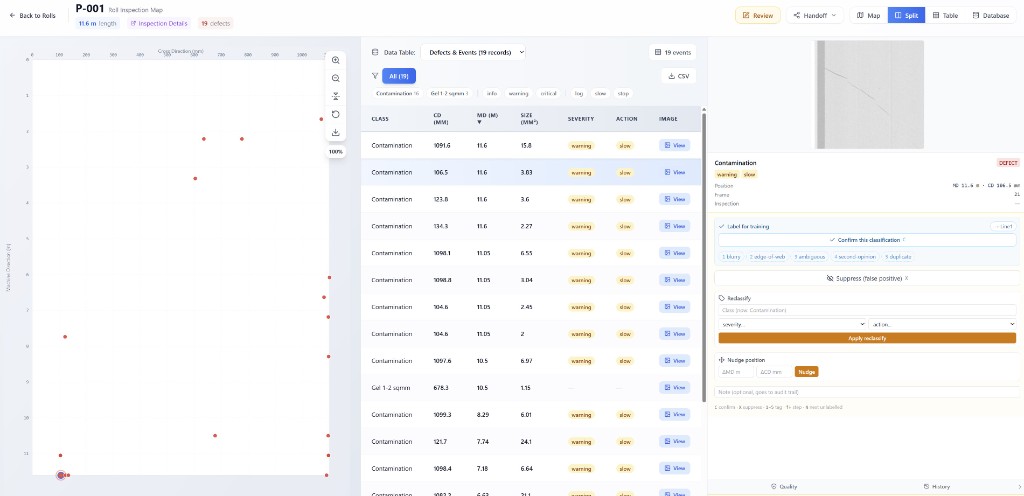
The plant hub that reviews, grades, slits and archives every roll from every line, and gets better with each roll your team reviews.
Define quality policies per product type. Roll Grader applies them automatically from the production order.
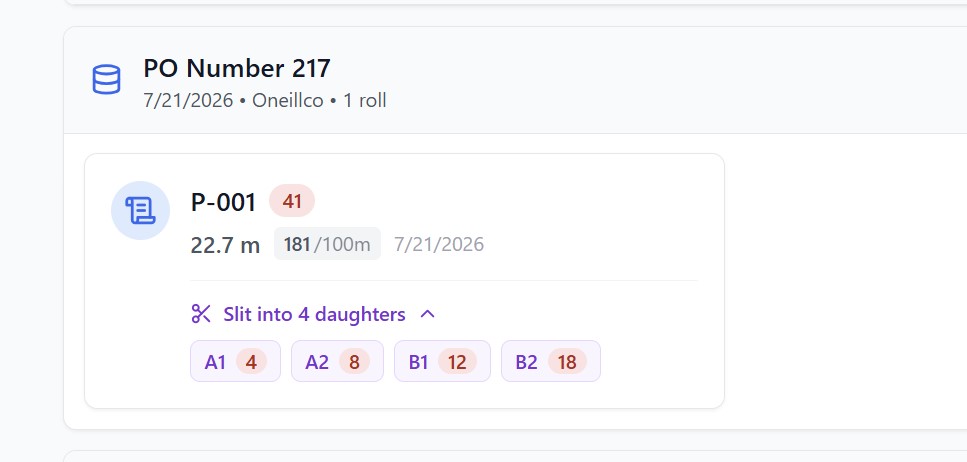
Plan daughter rolls from the graded map and hand the result to the slitter.
One repository for every roll on every line, with genealogy from master to daughter roll.
Uncertainty-ordered review queue. Confident cases are pre-approved; ambiguous ones get human eyes. Every correction trains the model.
Audit trail for every grading decision, exportable for customers and auditors.
Ingests from ImageFlow, Roll Tagger and third-party inspection systems.
Read: the quality and production cockpit for web converting · Read: process-directional inspection
A camera answers "what is this blob?". Roll Grader answers "what is the line telling us, and what should the operator do?" Every defect event lives at a machine-direction position, a cross-direction position and a time. Seven patterns cover what those events do, and each pattern points at one class of cause on every web process.
| Pattern | Signature on the roll | What it points to |
|---|---|---|
| Streak | Fixed cross-direction position, continuous along the roll | A stationary part at that CD: die lip deposit, doctor-blade nick, blocked dryer nozzle, scored guide roll |
| Repeat | Fixed machine-direction period, any CD | A rotating part with that circumference: chill roll, nip, embossing roll, plate or cylinder |
| Burst | Rate spike at a moment in time, then decays | A transient from a logged event: screen change, job start, adhesive batch change |
| Drift | Slow trend in rate or severity over hours or days | An ageing consumable or slow thermal shift: screen pack, blade wear, viscosity |
| Step | Sudden, sustained change in level | A discrete process change: resin lot, tension setpoint, new substrate roll |
| Edge | Concentrated in the outer CD bands | Edge handling or web geometry: neck-in, edge bead, trim knife, bubble instability |
| Scatter | Random in MD and CD at a stable rate | Process noise or environment: dust, resin contamination, airborne particles |
The detectors are built once; only the cause-to-action tables differ by process (extrusion, lamination and coating, printing, converting). Each table is drafted with your process engineers and ranked by operator feedback. Roll Grader advises; setpoint changes stay with the operator and the existing controllers.
Most false alarms and most missed diagnoses come from applying steady-state rules during a transition. Roll Grader tracks the state of every line from the events the plant already logs and interprets each defect against it.
From job start until the defect rate enters the expected band.
After any setpoint, roll or consumable change, until the rate returns to its pre-change band.
The full rule set applies; anything new is a real event.
A planned change in progress: job, roll, speed or consumable.
Rate outside band with no logged event to explain it.
Stop marks dwell damage; restart is a mini-startup.
For each line, product family and event type, Roll Grader learns the expected trajectory of each defect class after the event: the typical curve, a tolerance band, and the metres to return to steady. A live run is scored against its template.
In a plant that extrudes, laminates, prints and converts, a defect seen at the slitter may have been made three lines earlier. Carrying the defect map with the roll turns every downstream camera into a second inspection of every upstream line.
A repeat at the printer whose period matches the extruder's chill roll, corrected for stretch, is the extruder's problem. The advisor says so and raises it on the extrusion line, not the printer.
A faint gel line the extruder's camera missed becomes visible after printing. Projected back, it enriches the extruder's defect map and drift statistics.
When a roll with a known map is loaded, the downstream line is told where the defects will arrive and can skip, flag or slow instead of discovering them again.
A claim on finished product links back through the genealogy to the run, lot and process events of every line that touched it.
Each roll record carries its parent rolls and the transform between them: direction (reversed on every rewind), MD offset from trim and splices, stretch from lamination and printing, and the slit lane. Roll Tagger supplies the roll IDs and encoder truth that make the transform exact.
Each KPI is computed from data Roll Grader already holds.
| Startup waste per job | Metres from job start to template-confirmed steady state |
|---|---|
| Time to spec after a change | Settling time after a speed, roll or consumable change, against the template |
| Attributed defect share | Share of defect events with a confirmed cause |
| Upstream attribution rate | Share of converting and printing defects traced to an upstream roll |
| Mean time to diagnose an upset | From upset state to confirmed cause |
| First-pass yield by line and product | Good output over total output: the sum of the above |
| Deploys as | On-premise plant server |
|---|---|
| Sources | ImageFlow, Roll Tagger, third-party inspection systems |
| Outputs | Graded roll maps to Roll Tagger at slitter and unwind; reports; exports |
| Users | Quality managers, plant managers, process engineers |
| Licensing | Perpetual, per site |